
Which Loudoun County neighbourhoods flood
Drainage failures in Ashburn, Broadlands, Brambleton, and Lansdowne flood basements during heavy rain—and standard insurance won't cover it.
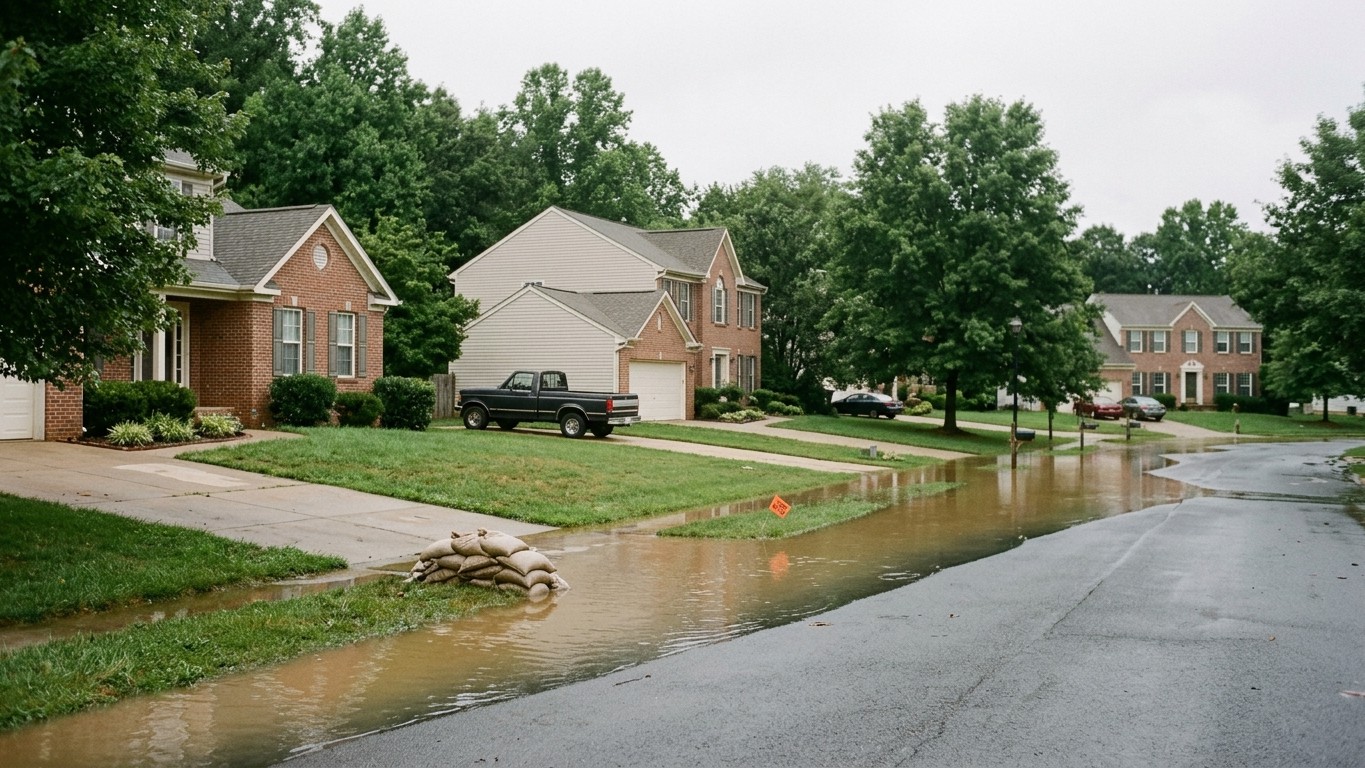
The flooding problem in Loudoun County that matters to someone choosing where to live is not the kind that appears on a FEMA map. We are not talking about homes in the shadow of the Potomac or Goose Creek, though those exist and do flood in the way the maps show. We are talking about the drainage problems in the newer developments, particularly in Ashburn, Broadlands, Brambleton, and Lansdowne, where heavy rain moves water into homes and basements not because a river has breached its banks but because the stormwater system cannot move water away fast enough.
When we first moved through the newer subdivisions in Ashburn, what struck us was how much has been built on what used to be field and forest, and how the stormwater ponds—which are supposed to hold water temporarily during heavy rain—were operating at or near capacity even during ordinary conditions. This is not a secret in the county. The Loudoun County Department of Transportation told us, as of now, that the stormwater infrastructure in many of these developments was built to handle storm frequencies based on older climate data and has not kept pace with the intensity of rainfall we actually see. In other words, a storm that was once considered a 100-year event happens more often now, and the pipes and ponds cannot absorb it.
Broadlands, which sits between Sterling and Ashburn, has had particular problems. In several instances, including storms in 2016 and later years, water has entered basements and first floors of homes in low-lying sections of the development. The developer, Toll Brothers, was involved in litigation over drainage issues, and as of now, the problem persists in certain neighborhoods within Broadlands. If you are looking at a home in Broadlands, particularly anywhere in the southern portion of the development or in areas closer to the detention ponds, it is worth asking about flood history and insurance costs. Getting the flood insurance disclosure from the seller is not enough—you want to talk to current neighbors about what they have experienced and how often.
Brambleton, the newer mixed-use development in Ashburn, has experienced similar issues. The development has expanded in phases, and the earlier phases did not always anticipate how much stormwater would accumulate on the site once the entire development was built out. Basements in Brambleton have flooded during heavy rains, and the problem is worse in the western sections of the development where topography channels water toward lower-lying neighborhoods.
Lansdowne, which stretches across both Ashburn and Leesburg, sits on terrain that naturally collects water. The development was built with stormwater management in mind, but again, the design did not anticipate current rainfall patterns. We spoke with residents who had water in their basements during the storms of 2020 and 2021, and this was not river flooding—this was the stormwater system failing to move water away quickly enough. Some of the lowest points in Lansdowne, particularly near its eastern edge, are more prone to this kind of drainage flooding than others.
Ashburn proper—the older, less densely developed portions around Lansdowne Boulevard and farther north—has fewer of these problems, in part because there is simply less built-out density and more pervious surface to absorb rainfall. The risk rises sharply in the newer subdivisions packed into Ashburn's center and western side.
Hamilton, the small town north of Leesburg, and Leesburg itself do sit closer to the Potomac, and flooding there is more likely to be river-related. During the flood of 1996 and similar high-water events, homes in the historic core of Leesburg near the river did take on water. This is a different problem than what we see in Ashburn or Broadlands, because it is predictable—FEMA maps show it—and flood insurance is cheaper if you understand the risk. River flooding is rare but catastrophic; drainage flooding in the newer suburbs is common and less severe but more difficult to insure for if the property is not in a designated flood zone.
Purcellville, in the western part of the county, sits higher and drains more naturally toward Catoctin Creek. We did not hear of systematic drainage problems there comparable to those in the central and eastern suburbs. Sterling, to the east, has some low-lying areas, but most of Sterling's neighborhoods are built on higher ground.
If you are buying in any of the newer developments in Ashburn, Broadlands, Brambleton, or Lansdowne, here is what matters: Do not rely on the seller's flood insurance disclosure alone. Call the Loudoun County Department of Transportation and ask whether the specific subdivision or neighborhood you are considering has had complaints about stormwater drainage. Look at the elevation of the property relative to nearby stormwater ponds and roads. Ask neighbors directly whether they have experienced water in the basement or yard during heavy rain. If you are on a lot that backs up to a stormwater pond or sits downslope from one, the risk is higher. Insurance quotes for these areas are climbing as insurers recognize these patterns, and many standard homeowners policies do not cover water damage from failed stormwater systems—only flood insurance does, but flood insurance is only available for properties in designated flood zones, which most of these drainage-prone developments are not. That gap is what you need to understand before you sign the contract.
Questions people ask
Is my home in a FEMA flood zone if I'm in Broadlands or Brambleton?
Most of Broadlands and Brambleton are not in designated FEMA flood zones, which is why standard flood insurance is not available to those homeowners. The flooding problem there is drainage failure, not river overflow, so it falls into a regulatory gap.
Can I get flood insurance for a drainage problem if I'm not in a FEMA zone?
Not through the National Flood Insurance Program. You would need to check whether a private flood insurer will cover drainage-related water damage, which is becoming rarer and more expensive. Many will not.
Which parts of Lansdowne have the worst drainage problems?
The western and lower-lying sections, particularly those near or downslope from stormwater detention ponds, have experienced the most frequent basement flooding during heavy rains.